The intersection of public safety and individual privacy has long been one of the defining challenges of law enforcement. Effective investigations, emergency response efforts, and crime prevention activities often depend on access to precise location information. At the same time, individuals possess legally protected privacy rights that govern when, how, and under what authority that information may be obtained. Advances in mobile technology continue to reshape this balance, creating new opportunities to protect privacy while raising important questions about the impact on public safety and criminal investigations.
At the same time, location data is a valuable commercial commodity. Mobile applications, advertising networks, data brokers, and telecommunications providers routinely collect, analyze, and monetize location information for a variety of business purposes. The competing interests of consumers seeking greater privacy, companies seeking to derive value from location data, and governments seeking lawful access for public safety have driven the development of technologies that can either obscure or reveal an individual’s location. These developments have significant implications for location intelligence, criminal investigations, and national security operations.
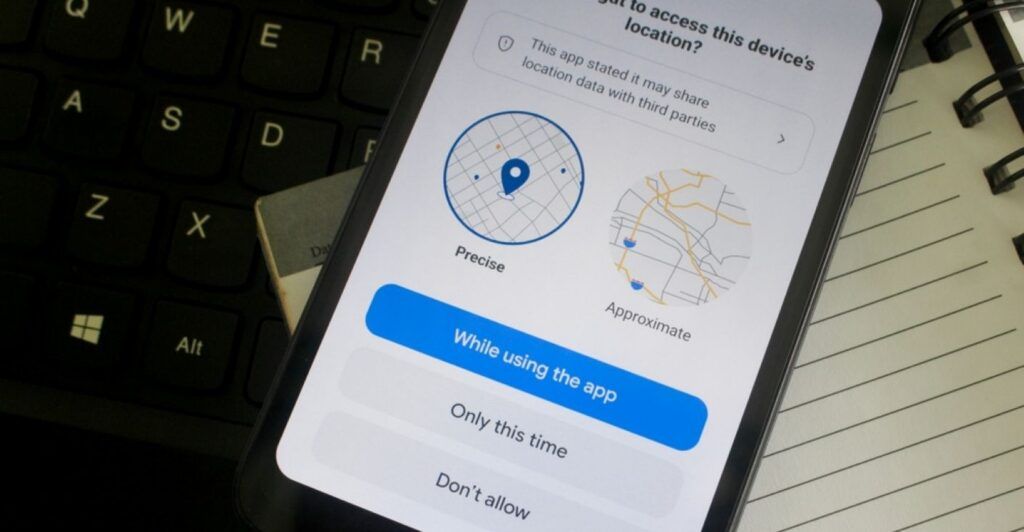
Apple introduced the Limit Precise Location feature for iOS devices in early 2026, which reduces the granularity of location information. When enabled on supported devices and networks, this setting prevents the handset from sharing its high‑precision GNSS and sensor‑derived coordinates with the mobile network. Instead, it returns a deliberately coarse, neighborhood‑scale location the size of a cell coverage area. The feature preserves emergency‑call location flows and provides app‑level precise location when the user explicitly grants it, but it blocks the handset‑assisted precision provided through carriers that law-enforcement analysts rely on.
Today’s limited adoption is constrained by requirements that handsets must be equipped with Apple’s in‑house C1/C1X modem hardware and iOS 26.3 or later, running on a 5G standalone (SA) carrier network. Over time, those barriers are expected to diminish as Apple expands deployment of its modem technology, customers upgrade devices and operating systems, and carriers continue to build out 5G SA networks. Consequently, the proportion of mobile devices that restrict the precision of carrier-assisted location information is likely to increase. Organizations that rely on carrier-derived location data for investigative, intelligence, and public-safety missions should anticipate a gradual reduction in the availability of high-precision network-based positioning information.
A Trajectory Shaped by Privacy Messaging and Commercial Advantage
It is assumed that Apple is presenting Limit Precise Location to its customers as a mechanism for finer control over their information. That would align with Apple’s long‑standing privacy positioning to consumers, as well as its broader strategy of differentiating its devices and services through privacy-focused features. By implementing this capability in its own modem and tying it to device and OS updates, Apple has the potential to gain greater influence over how location information is collected, shared, and used within its ecosystem. The company also lays claim to a unique privacy feature that is only available on its latest devices, encouraging upgrades and deepening preference for its ecosystem.
Users will continue to grant precise location information to apps that need it, such as ride-hail, navigation, and weather categories. Because app providers can share or sell that data, mobile advertising and app‑driven location services can remain viable. Carriers and enterprise customers that sell or license network‑derived location services such as fleet tracking, network analytics, and smart‑city applications may experience reduced positioning accuracy when serving users who enable the feature.
Apple’s move is likely to catalyze responses across the stack. Google and Android OEMs may adopt similar device‑level controls or implement technical workarounds in their modem and OS stacks. Carriers will evaluate whether to support the capability, adapt their enterprise offerings, or seek alternative data sources. Data brokers and ad platforms will continue to rely on app‑level feeds where consent exists, but they may also accelerate investments in probabilistic location models, Wi‑Fi fingerprinting, and other sources that are less dependent on carrier-provided location data.
The net effect will be a rebalancing of who controls and monetizes location intelligence, with device vendors and app owners on one side and carriers and brokers on the other. As the ecosystem adapts, new technologies, data sources, and service providers are likely to emerge to address gaps created by reduced access to precise carrier-derived location information.
Investigative Implications: Shifting Evidence Sources and Workflows
Carrier‑side pings and network‑assisted location have been reliable sources of near‑real‑time, street‑level positioning. Limit Precise Location has the potential to reduce the precision of that resource by removing handset‑assisted precision from carrier workflows outside emergency contexts. Investigators who have relied on carrier location to build timelines, corroborate witness statements, and locate suspects may increasingly encounter queries returning neighborhood‑scale results rather than the fine‑grained fixes they need.
Shifts in investigative workflows are likely to follow. Cases will increasingly rely on location traces from alternate sources such as app logs, ride‑hail histories, and cloud backups, distributed among many providers, which will require robust new technical and operational processes. Passive network collection that relies on carrier‑side signaling rather than handset assistance is expected to play a larger role, and digital forensic examinations of seized devices may become increasingly important sources of GNSS and sensor logs, cached maps, and other high‑precision artifacts. Advanced technical approaches such as Wi‑Fi and Bluetooth fingerprinting, camera and sensor correlation, and third‑party telemetry are also likely to be employed more frequently to reconstruct movement.
For law enforcement, the practical implication is that reliance on carrier‑assisted pings as a primary source of street‑level location information may diminish over time, and agencies should be prepared to diversify their technical and legal toolkits. SS8 location intelligence solutions address many of the gaps created by Limit Precise Location. SS8’s experience in fusing multiple network signals and presenting uncertainty metrics helps agencies produce defensible location estimates and expert testimony, and provides alternative investigative workflows that can help maintain operational effectiveness when precise carrier-derived location data are unavailable.
About Kevin McTiernan

Kevin McTiernan is a seasoned professional with over 20 years of experience in the security industry. His extensive expertise spans big data, cybersecurity, network security analysis, and regulatory compliance. As Vice President of Government Solutions at SS8, Kevin specializes in the implementation of advanced intelligence solutions for the U.S. Government, law enforcement, and the Five Eyes alliance. He is an accomplished public speaker and an adamant supporter and volunteer for the National Child Protection Task Force. You can learn more about Kevin on his LinkedIn profile.
About SS8 Networks
As a leader in Lawful, Location, and Data Intelligence, SS8 is committed to making societies safer. Our mission is to extract, analyze, and visualize critical intelligence, providing real-time insights that help save lives. With 25 years of expertise, SS8 is a trusted partner of the world’s largest government agencies and communication providers, consistently remaining at the forefront of innovation.
Discovery is the latest solution from SS8. Provided as a subscription, it is an investigative force multiplier for local and state police to fuse, filter, and analyze massive volumes of investigative data – in real time.
Intellego® XT monitoring, data fusion, and analytics portfolio is optimized for Law Enforcement Agencies to capture, analyze, and visualize complex data sets for real-time investigative intelligence.
LocationWise delivers the highest audited network location accuracy worldwide, providing active and passive location intelligence for emergency services, law enforcement, and mobile network operators.
Xcipio® mediation platform meets the demands of lawful intercept in any network type and provides the ability to transcode (convert) between lawful intercept handover versions and standard families.
To learn more, contact us at [email protected].